It would have been nice to visit the town, but three old men don’t need to risk a random flea bite. What struck me about this was the almost casual nature of the warning. I always assumed you would write THE PLAGUE!!! in all caps, and large, maybe boldface, type, with multiple exclamation points.
Last fall two old friends and I did a rapid road trip from Savannah out to the mountain west and back, our “Go West Old Man” tour. This last spring, March and April, I posted several blogs about the trip, tied to portfolios/galleries posted on my website.
Organizing a grouping of images based on some shared aspect is useful (thus galleries based on location-State/chronology/geography). Inevitably, in a total shoot of thousands of pictures, there will be some you really like, but that just don’t fit easily into any of the groupings.
This is one of those, an accidental find of a classic diner. I have several of these unicorns I’m calling “Outakes” which I will be sharing in the next few weeks.
Mary and Wiley Sanderson at his 90th Birthday Party
“Do not go gentle into that good night, Old age should burn and rave at close of day; Rage, rage against the dying of the light.” Dylan Thomas
Yes, this photograph is supposed to look like this, and no, it is not out of focus. In fact, everything in the photograph, from closest to farthest, is in exactly the same focus, because this was made with a pinhole optic, not a lens which would bend the light. By refracting the light with a lens we can make a selected distance much sharper, but then every other distance will be softer, the further from the focus point, the softer it will be.
Some might say that with smaller apertures on the lens we can make multiple distances sharp using greater depth of field. Not so. We can create the illusion of relative sharpness because of the “circles of confusion,” but I’m not going there.
I have mentioned my mentor Wiley Sanderson several times in this blog. Throughout my life I have had good teachers, formal and not. Sanderson was different. He was a hard, demanding teacher, the toughest I ever had, and I learned more from him than anyone I’ve ever met, except my parents, sister, and Barbara.
Here at his 90th birthday party I learned he had Alzheimer’s, but was assured he was doing well, contented, smiling, and happy. That was just wrong. If anyone was going to rage against the dying of the light I always thought it would be him.
So much student work at the beginning of his course sequence was done with pinhole, and most of his personal work explored so many possibilities of that approach. I don’t mean an oatmeal box with a needle hole punched in it. The pinholes we and he made used precision drilled apertures, giving us an accurate f stop and allowing a calculated exposure.
It seemed appropriate to use a pinhole to photograph him.
“And you are young and life is long, and there is time to kill today And then one day you find ten years have got behind you” “Time” Pink Floyd
The first thing she said was, “The barrels were so much larger then.”
I see my daughter and grand-kids infrequently. When my granddaughter first visited River Street Sweets she was about 5 and blown away, paralyzed by indecision. Twenty two years later, as we stepped out onto River Street she remembered the shop and wanted to go back to re-create the photo. We sort of did, here with her “baby” brother on her right (he missed the first visit by 4 years) and partner on her left, filling a bag, again.
Elaine Longwater, an old friend, passed away recently. She was independent and free-spirited with a big, generous heart, a strong business woman and a fine artist.
I don’t remember when we first met, but in the early 80s we were both part of a photo-centric group of friends. I had just moved back home after a year and a half working on a road crew, doing exploration drilling for lignite coal, and was looking for something, which I still can’t articulate.
I was spending a lot of time then walking along the Diamond and Shipyard Road causeways, photographing the marsh, looking for some kind of insight, maybe a bit like Thomas Wolfe’s longing for “A stone, a leaf, an unfound door….” (“Look Homeward Angel”) How elemental, how simplified can a composition be and still be dynamic?
Elaine’s home was a modest cottage on a large, wooded lot with enormous azaleas and camellias, fronting on a tidal creek with a long marsh view, on Burnside Island, at the end of Shipyard Causeway. It is a restful place, always seeming just on the edge of wildness, with the ebb and flow of water in the creek, and the light defining and redefining the landscape, ceaseless reminders the world is bigger than us.
She gave me an open invitation to go there anytime, whether anyone was home or not, to just hang, or photograph. I even did some oyster roasts, and there is no better roast environment than a chilly fall evening on a riverbank, on the marsh, with a big roaring fire.
It became a playground of sorts, a place where I could experiment, technically and aesthetically. I could try stuff just to see what it would look like. It didn’t have to be good, or satisfy client or critic. Failure is a big part of learning; there I was free to do that, and learning is so much easier when you are having fun.
We had some fun. We made some art. We made some memories. RIP Elaine.
We had been enjoying balsamic vinegar throughout our bicycling trip in the Po River valley, and knew we had to have some to bring home (along with some 30 and 48 month aged Parmesan Reggiano). Just writing this makes me want to run to the kitchen.
The shop, Giuseppe Giusti, was elegant in its simplicity. The staff was friendly and knowledgeable, explaining the making of balsamic, and offering tastings of different qualities/aging. As we were checking out I saw what I thought would be a very nice, formal, head and shoulders portrait: her warm-toned face, and the violet slash of the headscarf, surrounded by the neutrality of her black suit and the ground of black casks.
I asked if I could make her photograph, she said yes, and then immediately did this little vamp. Click. I think I like this better than the colder image I saw. Either way, I’ve learned not to “correct” a willing stranger-model. The photos will lose any natural feel from then on.
(This image is from a RAW file shot with the iPhone 15 Pro Max. Another way to get a “yes” sometimes is to not use an intimidating camera.)
My first exposure to balsamic was years ago, on one of the photo outings my Nikon colleague Bob Watts and I took. An old and close friend of his, Stanley Bucklin was not only a Leica rep, he marketed an Italian family’s balsamic products, and did taste testings. We spent the night with him and got an impromptu tasting event for the two of us. Bob remembers one bottle we tried was 100 years old, others decades. I just remember thinking, after sampling the most expensive offering, “I could drink that out of the bottle.”
“Dei Crocifissi” Simone di Filippo, mid 1300sItalo-Byzantine art at Pinacoteca Nazionale di Bologna
I can find something interesting in any time period/style of art, but I do have my favorites; for painting, Impressionism, and for sculpture, the Baroque, Bernini in particular. I confess to being dismissive of centuries of creative work, thinking anything prior to the Renaissance was just preparation for what came next (which I suppose is kinda always true about everything), and Byzantine work felt so flat I never spent much time looking at it. It also used a lot of gold leaf, which felt like void spaces in the composition, and, unlike some folks, I think a little gold goes a long way.
From a distance, taking in the whole of a Byzantine painting, it feels flat because it predates the use of perspective in drawing and painting, using visual illusions to suggest depth. Those clues could include linear perspective (parallel lines converge in the distance), aerial perspective (scenes at greater distances are hazier), overlapping, size constancy (the same object at a greater distance will be smaller).
But visiting the Pinacoteca Nazionale di Bologna’s collection of Italo-Byzantine work made me realize, I don’t think I had ever seen an original Byzantine piece up close, only reproductions in books, or slides in an Art History class. It was revealing. While the overall image might be flat, the interior details include substantial light and shadow modeling to give three dimensional feeling to the faces and features of the people in the scene. And in the gold leaf, the impressions made to create the halo give that dimension as well.
I haven’t changed my favorites, but came across a random show and it showed me something.
I have previously mentioned the strong influence my old professor/mentor (tor-mentor), Wiley Sanderson, had on my work. One of the great variety of weekly assignments he gave was to execute a diptych of “related” images. The thing was, you had to show something that went beyond any superficial, obvious connection between the two photographs, and he got to decide what was superficial, as well as what was too much a reach.
So, before you read any farther, study the two photographs and see what connections you can make between them, aside from both being made in Italy.
My argument for them being “related:”
One way to think of photographic composition is that it is simply an arrangement of assorted variations on three basic shapes–circle, triangle, and rectangle. I think the arches, horizontal lines, and rectangles of the two images repeat each other.
Another argument: while different in character, the color palette of both photographs is lush.
A couple of years ago Barbara and I decided we wanted to have more physical activity when we travel, so we signed up for a point-to-point self-guided bicycle ride along the Danube, mostly flat terrain, an “easy to moderate” physical ability category, and with e-bikes. The outfitter provides bikes, a GPS nav app, hotels along the route, and moves your luggage every day. Much of that trip was like a fairy tale setting of castles and vineyards, and ended in Vienna.
We recently finished our second of this type trip, riding in the Po River Valley of Italy, from Cremona to Bologna. It was a good trip, like Austria, but the difference in the landscape was dramatic, in reverse, sorta.
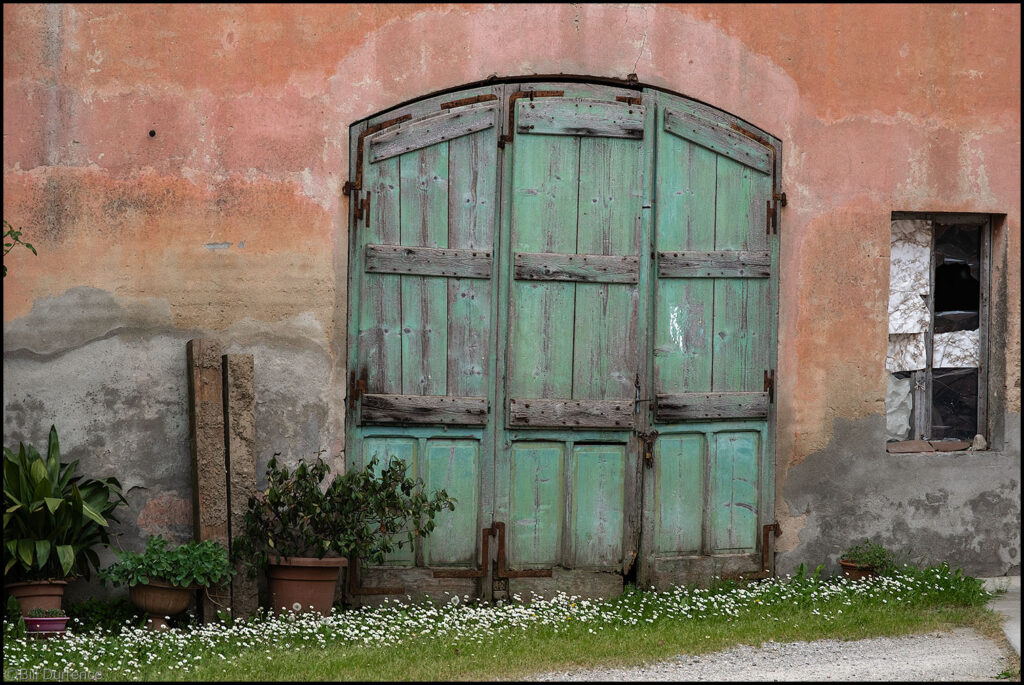
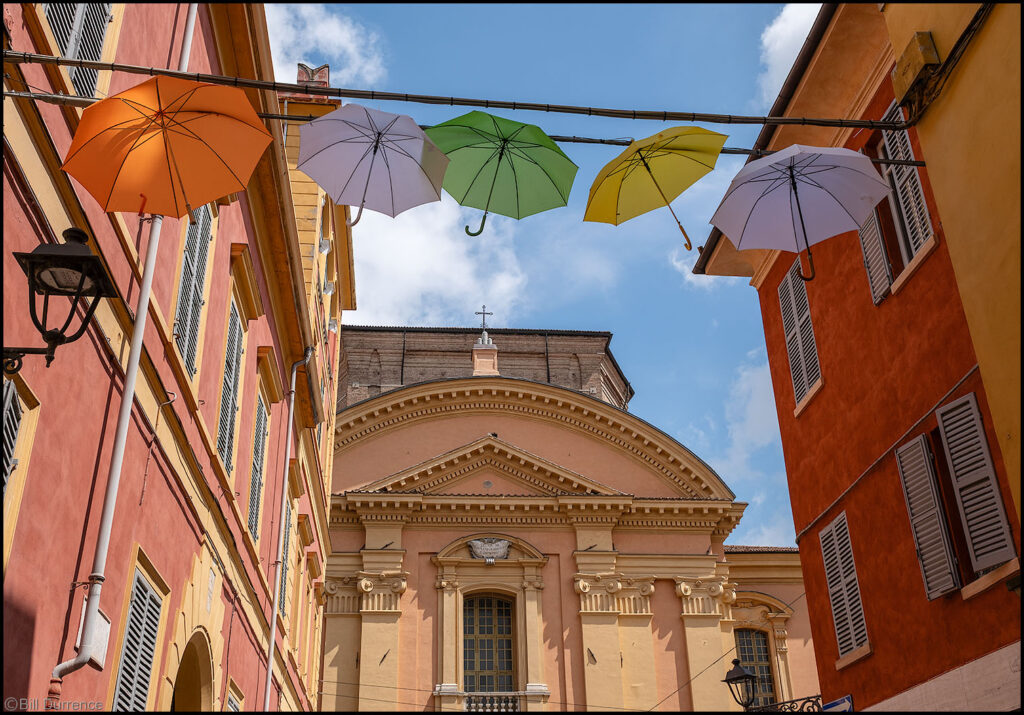
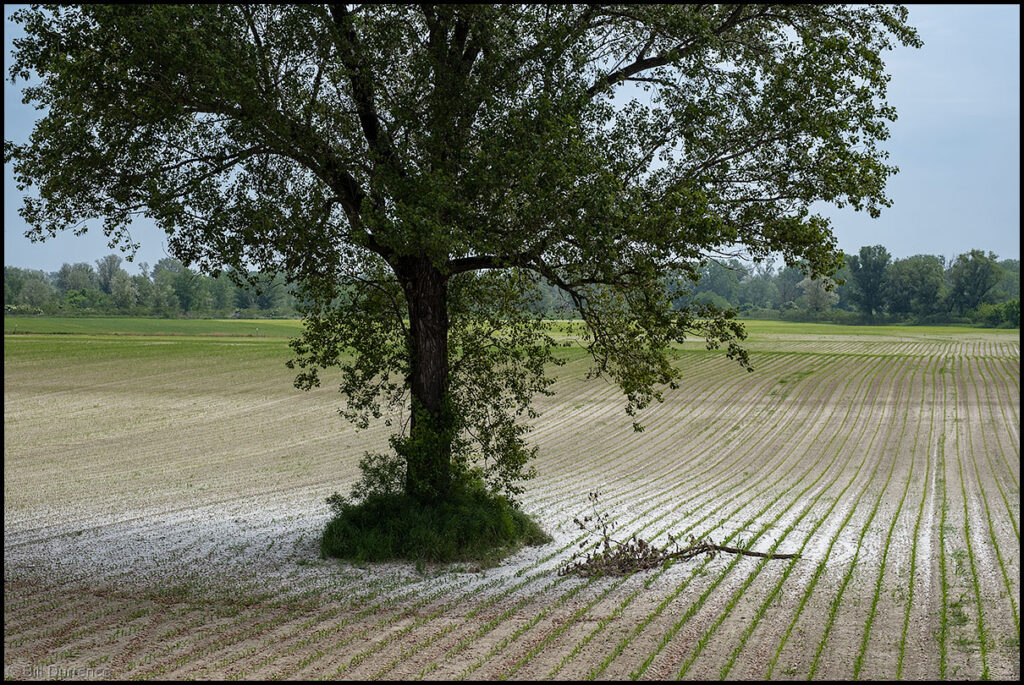
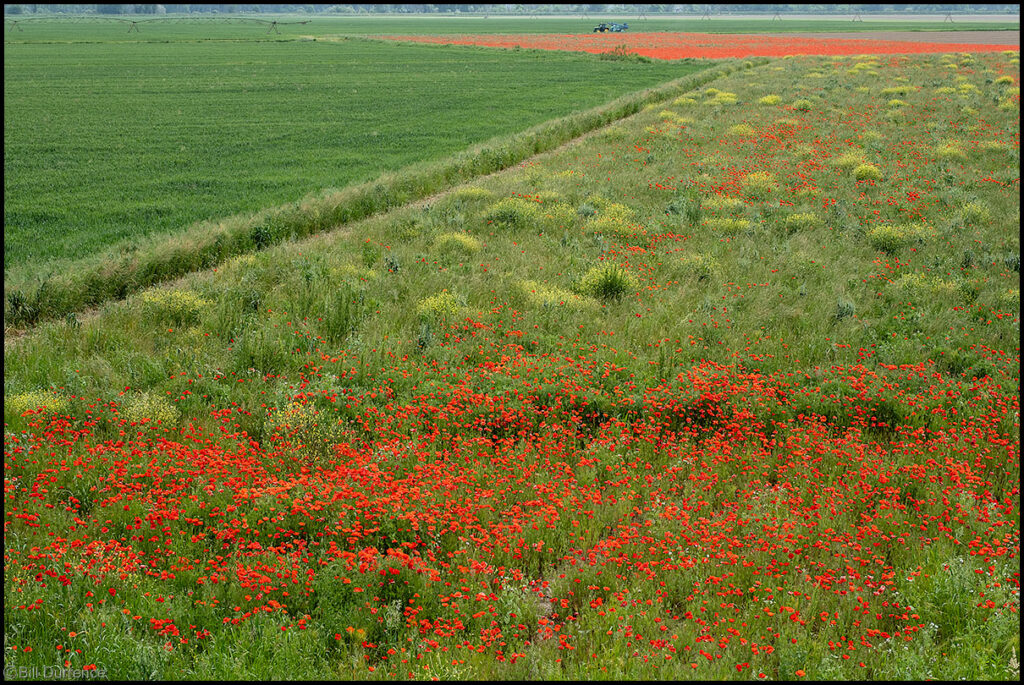
Where Austria is like a Disney set, the “Food Valley” of Italy is dominantly agricultural; our ride was mostly through farmland, a more mundane scene, but oh, the food. I “discovered” gramigna with a sausage sauce, and indulged in aged, thick balsamic vinegar drippled on aged Parmesan Reggiano.
As for photographing the “mundane,” I have often considered that my job is to find the extraordinary in the ordinary, or, as Thoreau put it, “The perception of beauty is a moral test.”
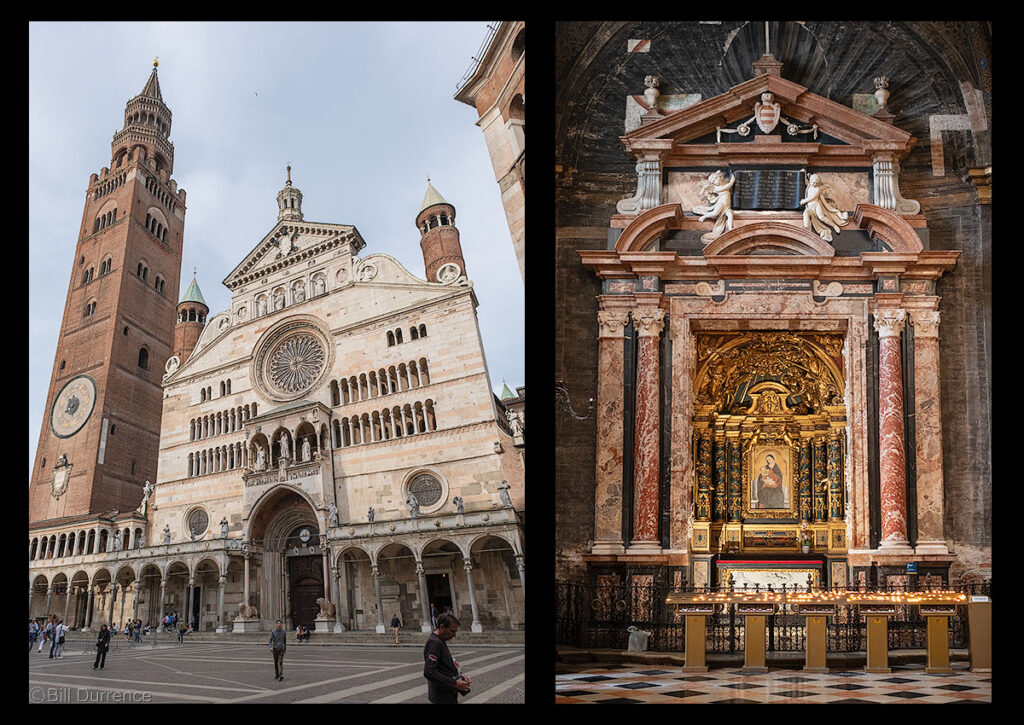
Duomo di Cremona, Cattedrale di Santa Maria Assunta
I read an essay recently that talked about an American visiting Europe, and frequenting churches and cathedrals, as a secular experience, for the Art and History. I understand that. I do that, and on our recent trip to Italy saw some smaller communities punch above their weight class with their edifice, and the volume and quality of artwork.
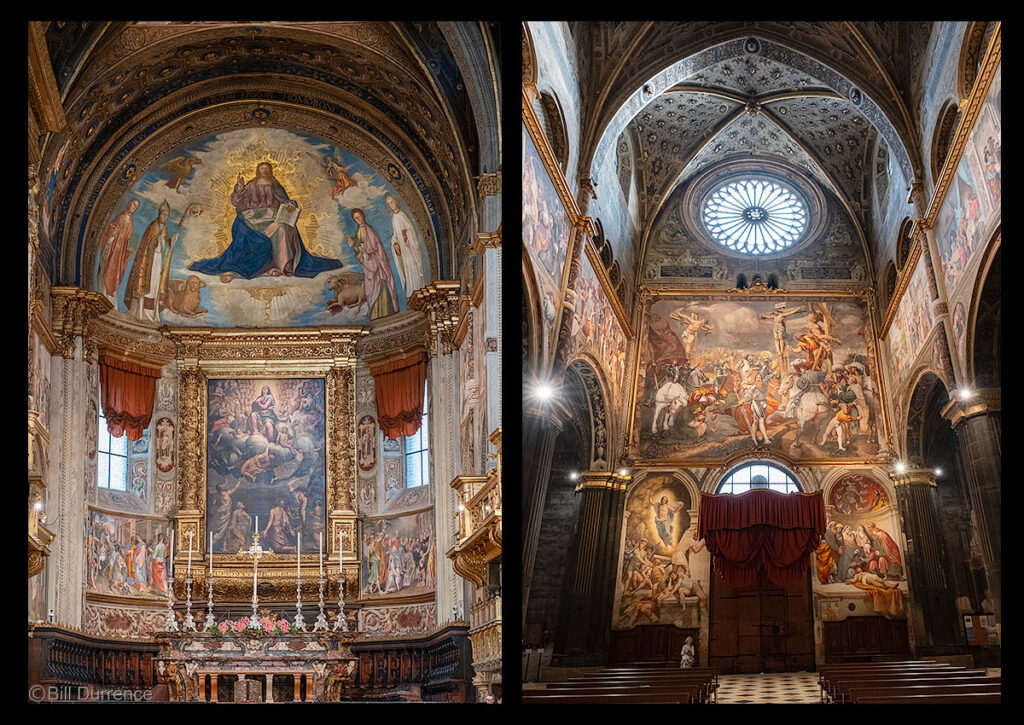
Cremona, birthplace of the modern violin and viola, is like that; only a population of about 72,000, but the city can be dated back to B.C.E. times, and was an early northern Roman outpost. The Cathedral on the main plaza is predominantly Romanesque, built in the 1100s, with some later styles showing up in renovations. The interior work is so extensive, and lush, it reminded me of when the Sistine Chapel was cleaned some years ago and the colors were so bright and vibrant, almost cartoonish, people thought they were wrong, but not.
In making my last shot (bottom right) I was mainly using Barbara (small white dot in lower middle) for a scale reference in the vast church setting. I didn’t see the giant tonsured friar, from the back, cowl down, arms raised to greet the crowd in the plaza with a benediction, until editing later.