
Athens, GA, 1974-75
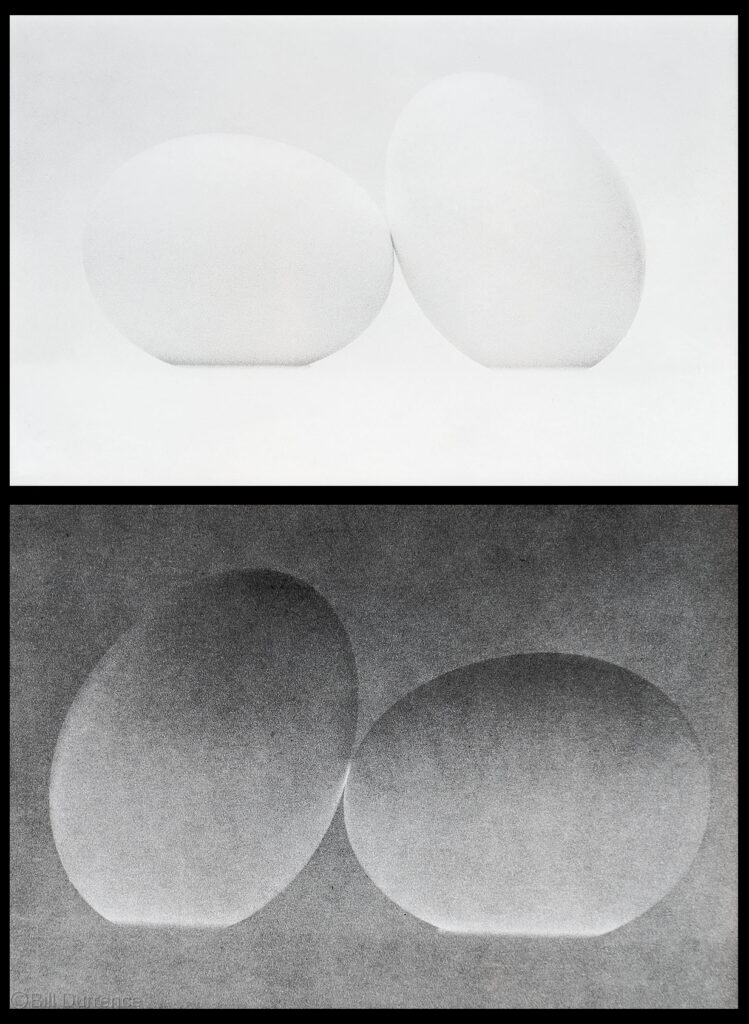
At the end of last week’s post I suggested a couple of exercises that were essentially taking the simplest subject you can find and trying as many distinct variations in photographing it as you can. Someone wrote me asking for examples, but going back into the files from so long ago, and digitizing them, is more effort than I’m willing to make. However, I did have one example handy.
This is from my days as a student in a Photographic Design course sequence. Our assignment was to shoot a “High Key” image. That means all tones in the photograph are at or lighter than a mid-tone. For the non-photographer, a mid-tone in this instance is very specifically halfway between black and white. For photo nerds, depending on one’s generation, it’s Zone V, or 128 on an 8 bit tonal scale.
I shot the eggs on a white ground with soft lighting. Something this simple might give a little idea how much you can do with changing camera position and/or lens, changing the lighting, or varying technical settings like aperture/shutter speed/ISO. And all that is before doing any editing of the photograph.
Then I made a standard print from the 35mm negative. (Remember this is in the chemical darkroom days.) Most photographic printing paper is “negative-acting” so when I printed the original negative onto photo paper I got a negative of a negative–a positive–the top photograph. Just as one example of the many directions you could go, I took that print and printed it (contact print) back onto another sheet of photo paper, creating a negative of a positive, getting a negative image–the bottom photograph. The texture picked up in that print is mainly from the fibers of the paper in the original print.
In today’s digitized, AI world, something like the above would be easy to create out of nothing, but the value of the assignment, regardless of medium, is not in finding the “right” answer (there is no right or wrong answer), but in what might be learned in exploring, experimenting.
For more of Bill’s photographs, go to https://www.billdurrence.com/index