
Botswana, 2011
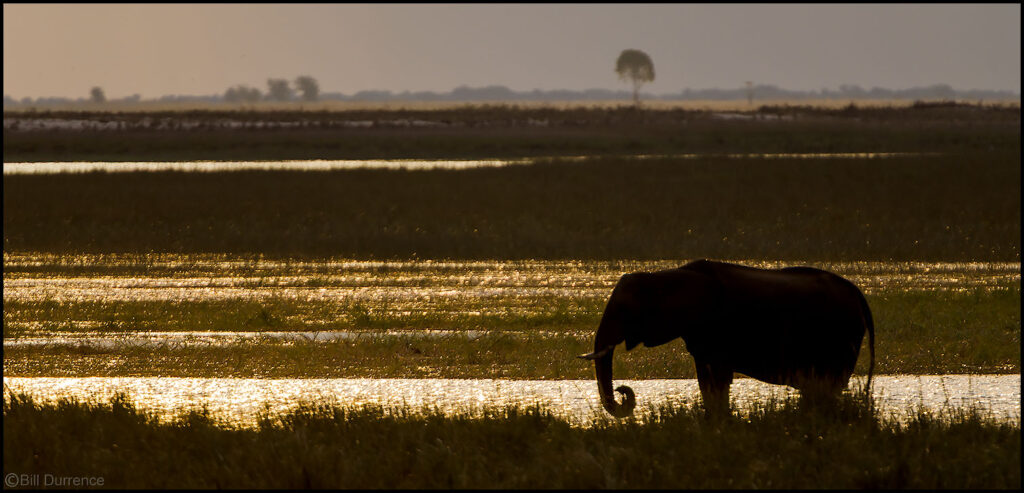
I pulled out an assortment of elephant photographs recently for a friend who likes elephants and was interested in purchasing a print. This was not the one he chose, but it is one of my favorites, now.
Our Botswana/Zimbabwe safari is one of so many trips or photo excursions for which I have never done a thorough edit. Looking for the elephant portfolio to show my friend led to me rediscovering this shot. Playing with editing helped me discover what I think I was “seeing” when I made it, although the original RAW, unedited file did not jump out at first.
We had previously done two safaris, both in east Africa (Kenya, Tanzania), so the trek to Botswana was very different visually. Where east Africa was mostly dry savanna, with really large herds of wildebeest interspersed with zebras, or mobs of Cape Buffalo, Botswana has wetlands, woodlands (and the Kalahari Desert), and what seemed like smaller herds, although that could be partly an effect of a more limited horizon line. That added another useful compositional tool, et voilà.
Using editing tools to illicit what I wanted from the original image reminded me of a recent conversation.
One of the most important benchmarks in a photographer’s career is when he/she understands they have acquired the technical skills and knowledge of exposure, processing, editing to be able to create a relatively accurate representation of the tones in the scene being captured. Today that means learning how to read a histogram.
The real revelation is even bigger and comes later–recognizing that those same skills can be used, not to mimic reality, but to make those tones whatever you want them to be. Why not? A photograph of a person, place, or thing is not that thing itself but, at best, a limited facsimile. The photograph is something new and can be interpreted any way the photographer should choose.
The great thing about Ansel Adam’s Zone System wasn’t just that it gave you the exposure and development tools to reproduce a midtone in the scene accurately as Zone V. It also gave you the ability and freedom to reproduce that midtone as any other tone you chose.
For more of Bill’s photographs, go to https://www.billdurrence.com/index.